
punnett square worksheet pdf
Punnett Squares are vital tools for predicting offspring genotypes and phenotypes, frequently utilized via downloadable Punnett square worksheet PDFs.
These worksheets offer practice with monohybrid and dihybrid crosses, aiding comprehension of dominant and recessive allele interactions.
Resources like those from mrgscience.com and calebwilkison.weebly.com provide structured exercises for mastering these genetic principles.
What is a Punnett Square?
A Punnett Square is a diagrammatic representation used in genetics to predict the possible genotypes of offspring from a particular cross or breeding experiment. Essentially, it’s a visual tool that helps illustrate all the different combinations of alleles that can occur in the progeny.
Many resources, including readily available Punnett square worksheet PDFs, demonstrate how to construct and interpret these squares. These worksheets typically present scenarios involving simple genetic traits, like pea plant color or mouse fur color, and guide users through the process of determining the probability of each genotype appearing in the next generation.
The square itself is divided into boxes, with the possible alleles from one parent listed along the top and the alleles from the other parent listed along the side. By filling in the boxes, you can see all the potential combinations. These worksheets, found on sites like mrgscience.com, are invaluable for beginners learning the fundamentals of Mendelian genetics and probability.
History of Punnett Squares ⎯ Reginald Punnett
Reginald Punnett, a British geneticist, developed the Punnett Square in the early 20th century. While the concept of allele segregation was established by Gregor Mendel, Punnett created a visual tool to easily predict the outcomes of genetic crosses. He wasn’t the first to use a tabular method, but his square became the standard representation.
Today, understanding Punnett’s contribution is often reinforced through practice, and Punnett square worksheet PDFs are widely used educational resources. These worksheets allow students to apply Punnett’s method to various scenarios, solidifying their grasp of inheritance patterns.
Resources like those available online, such as worksheets from mrgscience.com and calebwilkison.weebly.com, demonstrate how Punnett’s simple yet powerful tool continues to be fundamental in teaching and learning genetics. His legacy lives on in every student mastering these essential concepts.
Why Use Punnett Squares?
Punnett Squares offer a clear, visual method for predicting the possible genotypes and phenotypes of offspring from genetic crosses. They simplify complex inheritance patterns, making it easier to understand the probability of specific traits appearing in subsequent generations.
Utilizing Punnett square worksheet PDFs provides structured practice, reinforcing this understanding. These worksheets present diverse scenarios, from simple monohybrid crosses to more complex dihybrid examples, allowing students to hone their skills.
Resources like those found on mrgscience.com and calebwilkison.weebly.com demonstrate the practical application of Punnett Squares. They’re invaluable for analyzing genetic problems, predicting outcomes, and ultimately, grasping the fundamental principles of heredity. Mastering these squares builds a strong foundation for further study in genetics.

Monohybrid Crosses
Monohybrid crosses, frequently practiced with Punnett square worksheet PDFs, focus on tracking a single trait’s inheritance, simplifying genetic analysis for beginners.
Understanding Monohybrid Cross Terminology
Successfully navigating monohybrid crosses, often reinforced through practice with a Punnett square worksheet PDF, requires a firm grasp of key terminology. A monohybrid cross examines the inheritance of a single characteristic.
Genotype refers to the genetic makeup – the specific allele combination (like GG, Gg, or gg) – while phenotype describes the observable trait (e.g., green or yellow pea plants).
Dominant alleles (represented by capital letters, like ‘G’) mask the expression of recessive alleles (lowercase ‘g’).

Homozygous describes having two identical alleles for a trait (GG or gg), whereas heterozygous means having two different alleles (Gg).
Worksheets emphasize identifying these terms within cross problems, preparing students to accurately predict offspring characteristics and understand the probabilities involved in inheritance patterns.
Setting Up a Monohybrid Punnett Square
Mastering the setup of a monohybrid Punnett Square is fundamental, and Punnett square worksheet PDFs provide excellent practice. Begin by determining the genotypes of the parent organisms. These are placed along the top and side of the square.
Each parent contributes one allele for the trait being examined. The alleles from one parent are written across the top, and the alleles from the other parent down the side.
Then, each box within the square is filled by combining the corresponding row and column alleles. This represents a possible genotype for the offspring.
Worksheets often guide this process step-by-step, ensuring accurate allele combinations and a clear visualization of potential genetic outcomes. Careful setup is crucial for correct predictions.
Example 1: Green Pea Plants (Gg x gg)
Let’s illustrate with a classic example found in many Punnett square worksheet PDFs: crossing a heterozygous green pea plant (Gg) with a homozygous recessive yellow pea plant (gg). ‘G’ represents the dominant green allele, and ‘g’ the recessive yellow.
Place ‘G’ and ‘g’ across the top of the square, and ‘g’ and ‘g’ down the side. Filling in the boxes yields genotypes: Gg, Gg, gg, and gg.
This results in a genotypic ratio of 2 Gg : 2 gg. The phenotypic ratio is 2 green plants (Gg) to 2 yellow plants (gg), or simply 1:1.
Worksheets emphasize translating these ratios into understandable outcomes, reinforcing the link between genotype and observable traits. This example demonstrates how recessive traits can reappear in offspring.
Example 2: Tall Plants (TT x Tt)
Many Punnett square worksheet PDFs include crosses involving dominant and recessive traits, such as tall (T) versus short (t) plants. Let’s examine a cross between a homozygous tall plant (TT) and a heterozygous tall plant (Tt).
Constructing the Punnett square with ‘T’ and ‘T’ across the top, and ‘T’ and ‘t’ down the side, reveals the following genotypes: TT, TT, Tt, and Tt.
This yields a genotypic ratio of 2 TT : 2 Tt. Crucially, both genotypes express the dominant tall phenotype, resulting in a 100% tall plant offspring ratio.
Worksheets often ask students to interpret this, understanding that a dominant phenotype doesn’t guarantee a homozygous genotype. This example highlights how dominant alleles can mask recessive ones.
Example 3: Tall Plant x Short Plant (Tt x tt)
Punnett square worksheet PDFs frequently present crosses between heterozygous and homozygous recessive individuals, like a tall plant (Tt) crossed with a short plant (tt). This scenario effectively tests understanding of recessive allele expression.
Setting up the square with ‘T’ and ‘t’ across the top, and ‘t’ and ‘t’ down the side, generates the following genotypes: Tt, Tt, tt, and tt.
This results in a genotypic ratio of 2 Tt : 2 tt. Phenotypically, this translates to a 50% chance of tall plants (Tt) and a 50% chance of short plants (tt).
Worksheets emphasize recognizing that the short phenotype only appears when the recessive alleles are homozygous (tt). This demonstrates how recessive traits can reappear in subsequent generations.

Dihybrid Crosses
Punnett square worksheet PDFs extend to dihybrid crosses, tracking two traits simultaneously, demanding larger squares and increased complexity in allele combinations.
Understanding Dihybrid Crosses
Dihybrid crosses analyze the inheritance of two distinct traits concurrently, significantly increasing the complexity compared to monohybrid crosses. Punnett square worksheet PDFs often dedicate sections to mastering these more intricate scenarios.
These worksheets typically present problems involving traits like seed color and shape, or flower color and plant height, requiring students to determine the genotypes of the parents for both traits.
Understanding independent assortment is crucial; alleles for different traits segregate independently during gamete formation, leading to a wider range of possible offspring combinations.
Successfully tackling dihybrid crosses necessitates correctly identifying homozygous and heterozygous genotypes for each trait and accurately constructing a 16-square Punnett square to visualize all potential outcomes. Resources available online, such as practice worksheets, provide valuable support for students navigating these concepts.
The worksheets help solidify understanding of how to predict phenotypic and genotypic ratios in dihybrid crosses.
Setting Up a Dihybrid Punnett Square
Constructing a dihybrid Punnett square demands meticulous organization, as it involves tracking the inheritance of two traits simultaneously. Punnett square worksheet PDFs frequently guide students through this process step-by-step.
Begin by determining the possible gametes each parent can produce, based on their genotypes for both traits. For example, a parent with genotype AaBb can produce gametes AB, Ab, aB, and ab.
Next, create a 4×4 grid – a 16-square Punnett square – and label the rows with the gametes from one parent and the columns with the gametes from the other parent.
Then, fill each cell by combining the alleles from the corresponding row and column, representing the potential genotype of the offspring. Online resources and worksheets provide visual aids and practice problems to reinforce this skill.
Accuracy in gamete determination and grid completion is paramount for obtaining correct results.
Example: Seed Color and Shape
Let’s illustrate a dihybrid cross using seed color and shape in pea plants. Yellow seed color (Y) is dominant to green (y), and round shape (R) is dominant to wrinkled (r). Consider a cross between two heterozygous plants: YyRr x YyRr.
First, determine the possible gametes: YR, Yr, yR, and yr for both parents. A Punnett square worksheet PDF would visually represent this setup.

Construct a 16-square Punnett square, labeling rows and columns with these gametes. Filling the grid reveals the potential offspring genotypes.
The resulting phenotypic ratio is typically 9:3:3:1 – 9 yellow round, 3 yellow wrinkled, 3 green round, and 1 green wrinkled. Worksheets often present similar examples for practice.

Understanding this ratio demonstrates how alleles segregate independently during gamete formation, a core principle of Mendelian genetics.
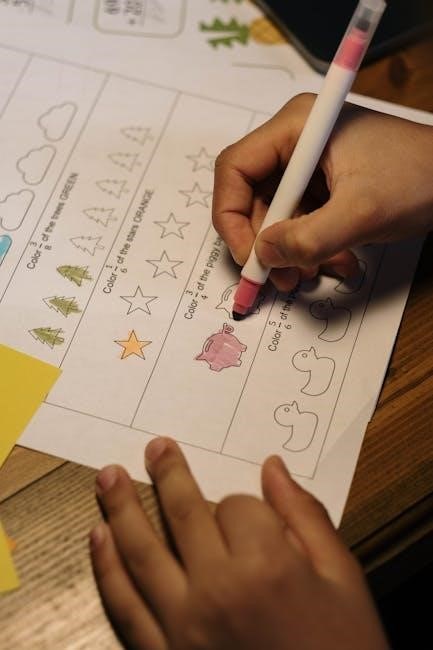
Punnett Square Practice Problems
Punnett square worksheet PDFs offer diverse problems, like those involving brown mice (BB x Bb) and white rabbits (Ww x Ww), to hone skills.
These exercises reinforce genotype and phenotype predictions.
Problem 1: Brown Mice (BB x Bb)
Let’s tackle the first practice problem from typical Punnett square worksheet PDFs: a cross between a homozygous dominant brown mouse (BB) and a heterozygous brown mouse (Bb), where tan fur is recessive.
First, determine the parent genotypes: BB and Bb. Now, construct a Punnett Square with ‘B’ alleles from the BB parent along the top and ‘B’ and ‘b’ alleles from the Bb parent along the side.
Filling in the square yields the following genotypes: BB, BB, Bb, and Bb. This results in a genotype ratio of 2 BB : 2 Bb.
Consequently, the phenotype ratio is 4 brown mice : 0 tan mice, as both BB and Bb genotypes express the dominant brown fur trait.
Therefore, all offspring from this cross will exhibit brown fur, demonstrating the power of dominant allele inheritance.
Worksheets often ask for both genotype and phenotype ratios for complete understanding.
Problem 2: White Rabbits (Ww x Ww)
This problem, frequently found on Punnett square worksheet PDFs, involves crossing two heterozygous white rabbits (Ww), where brown fur is recessive. Understanding this requires careful setup.
The parent genotypes are both Ww. Construct a 2×2 Punnett Square, placing ‘W’ alleles from one parent across the top and ‘W’ and ‘w’ alleles from the other parent down the side.
Completing the square generates the following genotypes: WW, Ww, Ww, and ww. This translates to a genotype ratio of 1 WW : 2 Ww : 1 ww.
The phenotype ratio is crucial: 3 white rabbits (WW and Ww) to 1 brown rabbit (ww). This demonstrates how recessive traits can reappear in subsequent generations.
Therefore, approximately 75% of the offspring will be white, and 25% will be brown, illustrating Mendelian inheritance principles.
These worksheets reinforce the concept of probability in genetics.
Problem 3: Red Flowers (Rr x Rr)
Frequently encountered on a Punnett square worksheet PDF, this problem explores the cross between two heterozygous red flowers (Rr), where white flowers represent the recessive trait. Accurate prediction relies on proper square construction.
Both parent genotypes are Rr. Create a 2×2 Punnett Square, allocating ‘R’ alleles from one parent horizontally and ‘R’ and ‘r’ alleles from the other vertically.
Filling the square yields genotypes: RR, Rr, Rr, and rr. This results in a genotype ratio of 1 RR : 2 Rr : 1 rr.
The corresponding phenotype ratio is 3 red flowers (RR and Rr) to 1 white flower (rr). This highlights the reappearance of the recessive trait.
Consequently, approximately 75% of the offspring will display the red phenotype, while 25% will exhibit white flowers, demonstrating Mendelian inheritance.
Worksheets like these solidify understanding of genetic probabilities.
Problem 4: Tall Plants (TT x Tt)
A common exercise found on a Punnett square worksheet PDF, this problem involves crossing a homozygous dominant tall plant (TT) with a heterozygous tall plant (Tt), where short stature is recessive.
Construct a 2×2 Punnett Square. Place ‘T’ alleles from the TT parent across the top and ‘T’ and ‘t’ alleles from the Tt parent down the side.
Completing the square generates the following genotypes: TT, TT, Tt, and Tt. This yields a genotype ratio of 2 TT : 2 Tt : 0 tt.
Since both TT and Tt genotypes result in the tall phenotype, the phenotypic ratio is 4 tall plants : 0 short plants, or 100% tall.
This demonstrates that even with a heterozygous parent, a homozygous dominant cross can maintain the dominant trait in all offspring.
These worksheets reinforce the principles of dominant and recessive allele inheritance.
Problem 5: White Rabbit x Black Rabbit (ww x BB)
Frequently appearing on a Punnett square worksheet PDF, this problem crosses a homozygous recessive white rabbit (ww) with a homozygous dominant black rabbit (BB), where black fur is dominant.
Setting up the Punnett Square involves placing ‘B’ alleles from the BB parent across the top and ‘w’ alleles from the ww parent down the side.
Completing the square results in all heterozygous genotypes: Bw, Bw, Bw, and Bw. This gives a genotype ratio of 4 Bw : 0 BB : 0 ww.
Because the black allele (B) is dominant, all offspring will express the black fur phenotype, despite carrying the recessive white allele.
Therefore, the phenotypic ratio is 4 black rabbits : 0 white rabbits, or 100% black.
This illustrates how a dominant allele can mask a recessive allele in heterozygous individuals, a key concept practiced on these worksheets.

Interpreting Punnett Square Results
Punnett square worksheet PDFs emphasize translating square outcomes into genotype and phenotype ratios, revealing probabilities of inherited traits from genetic crosses.
Genotype vs. Phenotype Ratios
Punnett square worksheet PDFs consistently require students to differentiate between genotype and phenotype ratios, a cornerstone of understanding inheritance patterns. The genotype ratio describes the proportion of different genetic combinations – for example, 2 GG : 2 Gg : 0 gg – representing the actual allele makeup.
Conversely, the phenotype ratio details the observable characteristics resulting from those genotypes. Using the previous example, the phenotype ratio would be 4 Green pea plants : 0 yellow pea plants, reflecting the expressed traits.
Worksheets often present scenarios where dominant alleles mask recessive ones, influencing the phenotypic expression. Accurately determining these ratios is crucial for predicting the likelihood of specific traits appearing in offspring. Mastering this distinction, through practice with these PDFs, solidifies a fundamental grasp of Mendelian genetics and probability in biological systems.
Determining Probability from Punnett Squares
Punnett square worksheet PDFs heavily emphasize translating the square’s contents into probabilities of inheritance. Each box within the square represents a potential genotype, and the proportion of boxes displaying a specific genotype directly corresponds to its probability of occurrence in the offspring.
For instance, if three out of four boxes show the genotype ‘Tt’, there’s a 75% probability of an offspring inheriting that genotype. Similarly, phenotype probabilities are derived from the phenotypic representation within the square.
These worksheets often ask students to express probabilities as fractions, decimals, or percentages, reinforcing mathematical skills alongside genetic concepts. Understanding these probabilities allows for predictions about future generations, a core application of Punnett squares and a key skill honed through consistent practice with these readily available resources.

Common Mistakes and Troubleshooting
Punnett square worksheet PDFs often reveal errors in assigning dominant/recessive traits or incorrectly setting up the square itself; careful review is crucial.
Incorrectly Assigning Dominant/Recessive Traits
A frequent error encountered when working with Punnett square worksheet PDFs involves misidentifying which allele is dominant and which is recessive. Students often struggle to correctly interpret problem statements, leading to inaccurate assignments of capital and lowercase letters.
For instance, if a problem states “tall is dominant,” the ‘T’ allele represents the dominant trait, while ‘t’ represents the recessive trait (short). Failing to recognize this relationship will result in an incorrect Punnett square setup and, consequently, flawed predictions about offspring genotypes and phenotypes.
Carefully reading the problem description is paramount. Look for keywords like “dominant,” “recessive,” or descriptions of the expressed trait when only one allele is present. Double-checking your allele assignments before constructing the square can prevent significant errors and ensure accurate results when completing the worksheet.
Remember, the dominant allele masks the expression of the recessive allele in heterozygous individuals.
Errors in Setting Up the Square
A common pitfall when tackling Punnett square worksheet PDFs lies in incorrectly constructing the grid itself. Students frequently make mistakes when placing the parental alleles along the top and side of the square. Ensuring each allele from one parent is correctly distributed across the top, and the other parent’s alleles down the side, is crucial.
For monohybrid crosses, a 2×2 grid is standard, while dihybrid crosses require a 4×4 grid. Failing to use the appropriate grid size immediately leads to an inaccurate representation of possible allele combinations.
Carefully review the parental genotypes before drawing the square. Double-check that you’ve separated the alleles correctly and placed them in the corresponding rows and columns. A systematic approach, and verifying the setup before filling in the boxes, minimizes errors and ensures accurate predictions.